From Tsinghua to Tongxiang: Why Entrepreneurs Choose Wuzhen


An Interview
An article for entrepreneurs, whether you’re just starting out or looking to grow your business, or anyone interested in Wuzhen's development.
Junlin Yang
During my research into Wuzhen’s transformation, I became increasingly interested in a question: why do entrepreneurs choose to build their companies here?
Wuzhen is surrounded by some of China’s most economically developed cities. Shanghai, Hangzhou, Shenzhen, and Beijing all seem to offer obvious advantages to someone starting a company. So when I learned that I would have the opportunity to interview entrepreneurs who had studied at Tsinghua University and later pursued PhDs at USC, I immediately wanted to ask them one thing:
Why Jiaxing?
Why would someone with access to some of China’s largest cities choose to build a company only a short distance from Wuzhen?
One of the companies I visited was Zhisu Health Technology, a medical technology company developing personalized orthopedic implants through 3D printing and digital materials technology. The company was founded by a team with backgrounds at Tsinghua University and overseas research institutions before eventually establishing its operations in Jiaxing.
Their work focuses on using patient-specific data to develop customized orthopedic implants. It brings together the scientific research that first interested the founder as a university student with the engineering and medical applications he eventually pursued.
For me, however, the company became interesting for another reason. Its story offered a completely different perspective on why an entrepreneur might choose a place like Jiaxing.
From Physics to Entrepreneurship
I had the amazing opportunity to interview an entrepreneur from this company. I began our conversation with a question I had asked several of the entrepreneurs I interviewed:
When did you first start thinking about entrepreneurship?
His answer took me back to his time at Tsinghua.
As a physics student, he was already thinking about China's position in the global manufacturing industry. China had become one of the world's largest manufacturing countries, but he believed that becoming a true manufacturing power would require stronger original technology and innovation.
That was one of the reasons he initially chose physics.
He wanted to understand science at its most fundamental level, yet his interests quickly extended far beyond his major. At Tsinghua, he explored economics, philosophy, materials science, chemical engineering, mechanical engineering, robotics, and fuel cells.
He described himself as an unconventional engineering student because he was always asking the same question:
If I learn this, what can I actually do with it?
That question eventually changed the direction of his career.
He became increasingly interested in how scientific knowledge could become something useful in the real world. This eventually led him toward engineering and medical technology.
I found this especially interesting, making me reconsider how entrepreneurship actually begins. I had often thought of entrepreneurship as starting with an idea for a product, but his experience suggested something much earlier than that step. For him, it started with curiosity about how knowledge he learned could be applied.
Why Jiaxing?
Of everything we discussed, this was the question I was most eager to ask.
Why here? Why Jiaxing?
He told me that Jiaxing was not necessarily the only option. Shenzhen had also tried to attract the company. Yet after considering different possibilities, he saw something particularly valuable in Jiaxing.
Its location was one factor.
Jiaxing sits within the Yangtze River Delta, close to major cities while remaining outside their much more competitive environments. For a medical technology company, this creates convenient connections with hospitals, research institutions, manufacturers, and other businesses.
Throughout the conversation, he kept returning to one word:
“人和.”
The relationships between people.
He described the early stages of entrepreneurship as a particularly fragile period. He compared a young company to a small tree. Before it grows strong enough to withstand difficulties on its own, even a relatively small problem can affect its survival.
For him, Jiaxing provided people who were willing to help that small tree grow.
Before this interview, I usually imagined one through things that could be measured more easily. How much investment does a city attract? How many startups are located there? How advanced is its infrastructure?
His answer made me think about something harder to measure.
Do people actually want to help each other?
A city can have excellent infrastructure and still feel difficult for a young entrepreneur to enter. In his experience, Jiaxing offered an environment where relationships could make the early stages of building a company easier.
Jiaxing's business environment appears to support this. By the end of 2024, the city had nearly 800,000 market entities, with private businesses making up more than 96 percent of them. The city has also introduced policies designed to reduce business costs and support technology startups through subsidies.
Before beginning this research, I honestly did not know that the area around Wuzhen had so many entrepreneurial opportunities.
As someone who has built my own startup, I was especially excited to discover that the place I had always associated with the theatre festival and traditional Chinese culture also existed within a much larger entrepreneurial ecosystem.
Entrepreneurship Means Dealing With People
I then asked him what he considered the hardest part of entrepreneurship.
I expected him to talk about technology. Maybe funding. Maybe competition.
Instead, he talked about people.
He explained that young entrepreneurs often enter the business world with a natural assumption that others can be trusted. This assumption can become dangerous once money and business relationships enter the picture.
He emphasized the importance of looking beyond what someone says. An entrepreneur needs to understand a person's actions, reputation, background, and relationships before deciding whether to work with them.
His advice was straightforward:
Understand the positive and negative sides of human nature.
I found this surprisingly different from the entrepreneurship I had encountered through business competitions.
In a competition, entrepreneurship can seem almost formulaic. Find a problem. Develop a solution. Research the market. Build a business model. Pitch the idea.
His experience made entrepreneurship seem much less predictable.
A strong product can still encounter problems because of a business partner. A promising company can lose time because of the wrong supplier. A relationship that seemed reliable at first can become a serious problem once money is involved.
The more I listened, the more I realized that entrepreneurship involves understanding people as much as understanding markets.
The Meaning of Networking
This naturally brought us to another word I had heard throughout my own experiences with entrepreneurship:
Networking.
Before this interview, I thought of networking mainly as meeting people who might eventually help you.
His definition was much deeper.
He described networking as a form of trust.
When an entrepreneur meets someone new, a résumé can tell you where that person studied or worked. It cannot necessarily tell you how they treat their partners or whether they keep their promises.
A mutual connection can.
Someone who has worked with that person before can tell you what they are actually like. A former classmate can introduce you to someone who might otherwise never respond. A mentor can open a door that would have been difficult to find alone.
His own network began decades ago at Tsinghua.
He described maintaining relationships with alumni across different industries and parts of China. One story was especially memorable: He once organized a football gathering that brought together more than 200 Tsinghua alumni from different places.
The value in these "social events" was in the relationships that had accumulated over time.
This story changed my understanding of networking completely. Perhaps the most useful network is not the one with the greatest number of people, but one where people know each other well enough to trust one another.
From Technology to Commercialization
I was also fascinated by his perspective on technology.
Zhisu Health Technology works in an extremely technical field. The company develops personalized orthopedic implants using digital materials technology and 3D printing, with patient-specific data informing the design of implants.
The company has also developed 3D-printed cervical and lumbar fusion products that received FDA approval.
Listening to him speak about the company, however, I quickly realized that creating advanced technology was only part of the challenge.
He talked about patents, imitation, intellectual property, branding, and business models.
A technology can eventually be copied. A competitor may reproduce a technical feature. Even patents involve difficult decisions because protecting intellectual property requires resources, and the patent itself can reveal information about the technology.
That means an entrepreneur has to think carefully about where the actual value of a company comes from.
Sometimes it comes from the product. Sometimes it comes from the brand. Sometimes it comes from licensing or partnerships.
AI and the Future of Healthcare
Eventually, our conversation moved toward AI.
His vision for AI in healthcare was much bigger than using AI to make doctors' work faster.
He explained that medicine still relies heavily on the experience of individual doctors. Two doctors can examine the same patient and reach different conclusions because their experiences are different.
AI could change this.
Imagine a system that could compare a patient's information with millions of previous cases. It could identify patterns that an individual doctor might never encounter during an entire career. It could help determine which treatment may be most appropriate for a particular patient and even suggest which type of hospital is best suited to the case.
For a company developing personalized orthopedic implants, this idea feels especially relevant. The larger possibility in AI is using data to understand what a particular patient needs. With the development of newer and better technology, the healthcare industry is becoming increasingly more personalized for the patient.
Starting Small
One of the pieces of advice I found most useful was surprisingly simple:
Start with a smaller market.
He warned me against assuming that the largest possible market is always the best place to begin.
A huge market attracts large competitors. A young company may struggle to survive if it tries to compete everywhere from the beginning.
A smaller market can give a startup enough room to understand its customers and improve its product.
He encouraged me to think about my own startup in the same way
The interview helped me understand that starting with a narrow market does not mean having a narrow vision.
Sometimes you need to start somewhere specific before you can understand where you can go next.
What I Took Away
I did not leave the interview with a formula for becoming a successful entrepreneur. In fact, one of his strongest points was that entrepreneurship cannot simply be copied.
Every entrepreneur starts with different knowledge, relationships, resources, and circumstances. Even if two people follow the same strategy, their results can be completely different.
This interview helped me see how Wuzhen became much larger than Wuzhen itself.
Only a short distance away from the streets where I had spent years watching the theatre festival, entrepreneurs were developing 3D-printed medical implants and thinking about the future of healthcare.
I found that contrast fascinating.
I came back to Wuzhen expecting to study how a heritage town had developed. Instead, I began meeting the people who are still developing the region themselves, and that's what's especially special about this small town.


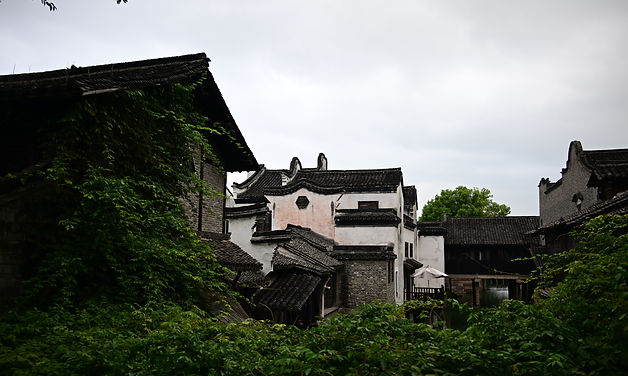
Picture of Wuzhen
